

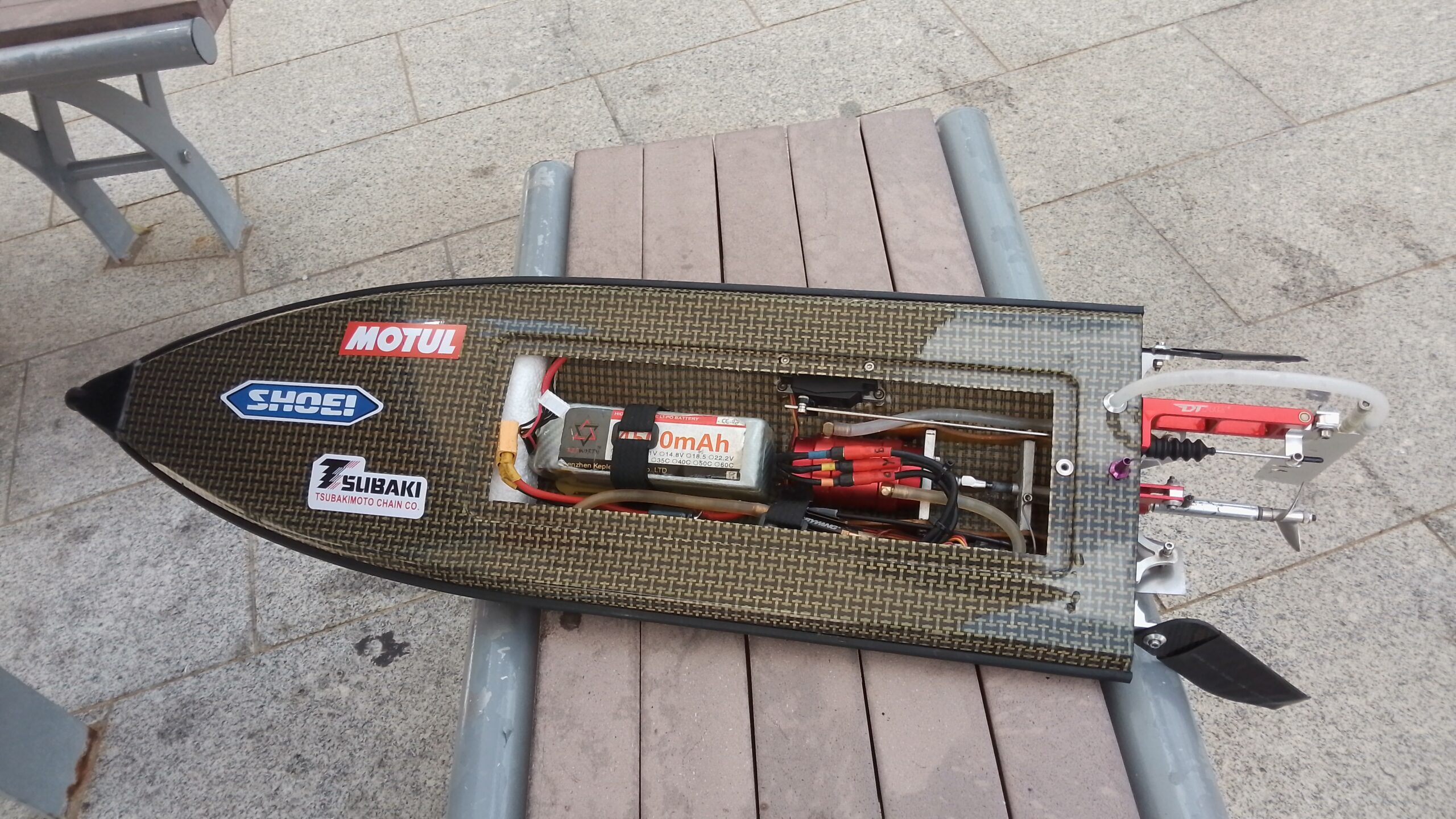
There is a specific kind of heartbreak that only RC enthusiasts understand. You spend hours charging batteries, checking flex shafts, and waterproofing receivers. You drive to the lake with the excitement of a kid on Christmas morning. You place your sleek, missile-like vessel on the water, take a deep breath, and punch the throttle. The scream of the motor is primal. The rooster tail is epic. Your boat transforms into a blur of fiberglass and speed… and then, roughly one hundred and eighty seconds later, the low voltage cutoff kicks in and your pride and joy becomes a drifting paperweight.
If you own a high-speed RC boat powered by a 6S LiPo battery, you know this pain intimately. We are talking about the three-minute miracle, that fleeting window of insanity followed by the long, silent paddle of shame back to shore. It begs the question: if these batteries are so powerful, why can’t we seem to enjoy them for more than the length of a single song?
To understand the short runtime, you have to appreciate the immense power required to defy one simple fact: water is roughly eight hundred times denser than air. Unlike a basher truck that spins its tires in the dirt with relatively little resistance, a boat has to physically shove thousands of pounds of that dense water out of the way just to get moving. To achieve the kind of speeds that make 6S power worthwhile—fifty, sixty, or even seventy miles per hour—you need an absurd amount of torque and RPM.
A 6S setup delivers twenty-two point two volts of raw energy, spinning a stainless steel propeller at truly insane speeds. But spinning that prop that fast creates massive drag. The motor has to fight that resistance constantly and without mercy. There is no coasting in a boat; the second you let off the gas, the water acts as a giant brake, sucking that forward momentum right out of the hull. Speed costs energy, and in water, that cost is exponential.
Let’s consider the battery itself. A standard pack for a fast boat might be a five-thousand milliamp hour 6S LiPo. Now, imagine your speed controller is working hard, pulling a hundred amps continuously to keep that propeller churning. When you do the math, that combination of capacity and demand shakes out to roughly three minutes of full-throttle run time. This isn’t a design flaw or a manufacturing defect; it is simply the arithmetic of high-performance systems. If you are running a particularly aggressive propeller or a hot motor, the current draw spikes even higher, and that three-minute window shrinks even further.
Some might think that moving from a smaller 3S battery up to a 6S would double the fun, but in practice, it does the opposite. In the RC world, when we double the voltage, we usually prop up to take advantage of the increased speed potential. We aren’t running 6S to go the same speed as a 3S boat; we are running it to go warp speed. This means the motor pulls significantly more total wattage, and more watts equals more speed but inevitably equals less time on the water.
Beyond the pure electrics, the physical setup of the boat plays a huge role in those precious minutes. If the propeller is too large or has too much pitch, it acts like a shovel in the water, creating immense load and turning your motor into a space heater rather than a propulsion system. If the drive strut is angled incorrectly or sitting too deep, you are basically dragging a parachute underwater without realizing it. And let’s not forget the weight. A 6S boat is heavy, carrying two hefty packs that have to be pushed onto plane, requiring a huge burst of energy just to get the hull out of the hole shot.
Finally, we stop at three minutes because we have to. LiPo batteries are notoriously finicky. If you try to drain a 6S pack down to zero percent, squeezing out an extra thirty seconds of run time, you risk damaging the cells, causing swelling, or in worst-case scenarios, starting a fire. We set our timers for three minutes to ensure that when we bring the boat back to shore, the battery is resting at a safe voltage. That buffer is crucial for battery longevity and for keeping our hobby from going up in smoke.
So how do we deal with this bittersweet reality? The most effective strategy is to simply embrace the hot lap mentality. Treat your runs like Formula 1 qualifying sessions and make every second count. High-speed boating isn’t about a leisurely cruise across the pond; it is about a concentrated adrenaline rush. Alternatively, you can buy batteries in bulk, adopting the golden rule that the number of packs you own should roughly equal the number of minutes you want to run, divided by three. If you want to play for an hour, you need twenty batteries and a very patient wallet.
Is a three-minute runtime frustrating? Absolutely. When you drive an hour to a pond, you want to play for more than a song and a half. But here is the secret that keeps us coming back: those three minutes are often the most exhilarating three minutes of your entire week. It is a pure, concentrated dose of speed and noise that you simply cannot get from a crawler or a basher. So charge up those 6S packs, set your timer, and enjoy the show. Just make sure you have another pack ready to go.
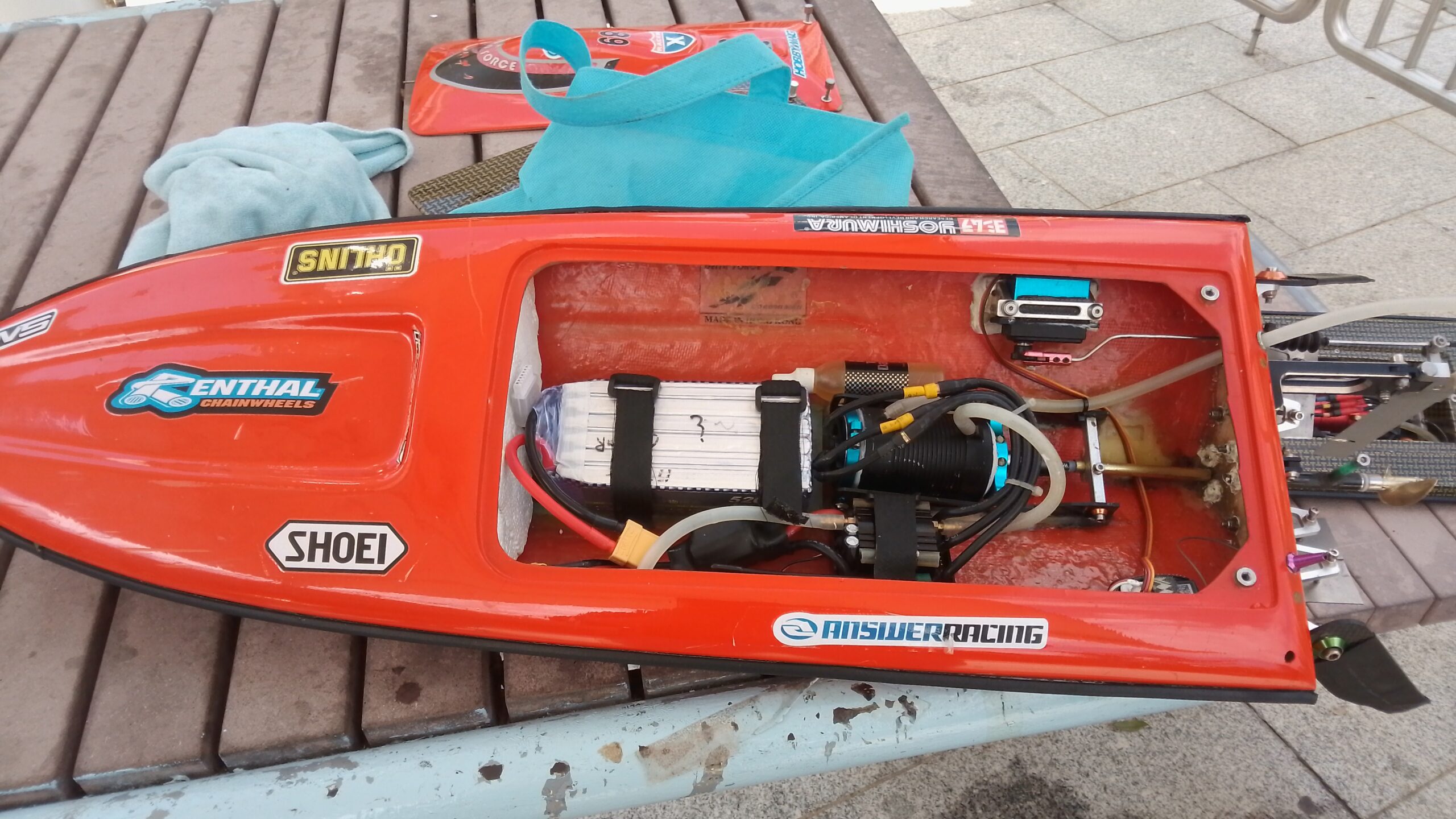
So there you are. You’ve just experienced the three-minute miracle. Your heart is still pounding from the sheer insanity of watching a tiny fiberglass missile dance across the water at sixty miles an hour. The motor is silent now, the boat bobbing gently on the swell somewhere out in the middle of the pond. And you are standing on the shore, holding a radio transmitter that might as well be a brick.
This is the moment the Low Voltage Cutoff does its job. It saved your expensive 6S LiPo batteries from certain death. But in doing so, it has stranded your pride and joy in no-man’s-land. You try the throttle again, hoping for a miracle. Nothing. You hear the faint, mocking beep of the ESC, a constant reminder that you are powerless.
Welcome to the paddle of shame.
For the uninitiated, the paddle of shame is that humbling ritual where a grown adult, who moments ago was commanding a vessel of immense speed and power, must now resort to throwing rocks near their boat hoping the ripples will push it closer, or worse, stripping down to their underwear for an impromptu swim. The water is always colder than you expect, and the bottom is always muddier.
This is why, in the world of high-speed RC boating, the rescue boat isn’t a luxury. It is an absolute necessity.
Think of it as maritime roadside assistance. You wouldn’t drive a rally car flat out through the forest without a support vehicle, would you? The same logic applies here. When you are pushing the limits of 6S power, you are voluntarily accepting that the battery cutoff is going to activate. It is not a matter of if, but when. And when that moment comes, you need a plan that doesn’t involve hypothermia.
A dedicated rescue boat is typically the opposite of your speedster. It is slow, ugly, and practically unsinkable. Often it is a tugboat-style hull or a modified fishing boat running on a low-voltage, long-duration setup. It carries no ambition for speed records; its sole purpose is to lumber out to the middle of the lake, nudge your dead investment back to shore, or in some clever setups, latch onto it with a solenoid-activated release mechanism.
The alternative to owning one is relying on the kindness of strangers. You scan the shoreline for another boater, hoping they haven’t already packed up. You wave pathetically, miming a pushing motion, hoping they understand your plight. If you’re lucky, another enthusiast will launch their own rescue vessel and save the day. If you’re unlucky, you watch as a gentle breeze slowly pushes your prized asset towards the far, reedy, inaccessible bank where it will surely snag and spend the night.


