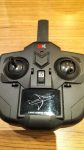

This XK250 does not have rudder (the vertical stablizer is completely static). It turns by manipulating the aillerons.

In an RC plane, turning using ailerons rather than the rudder is a technique primarily used in fixed-wing aircraft with more advanced control surfaces. Here’s how it works and why it’s different:
Ailerons are located on the trailing edge of the wings, typically near the wingtips, and are used to control roll. When you deflect one aileron upward and the other downward, it creates a difference in lift between the two wings. The wing with the downward-deflected aileron generates more lift, while the wing with the upward-deflected aileron generates less. This causes the plane to roll or tilt to one side, aligning the aircraft’s lift vector in the direction of the turn.
Once the plane rolls to the desired angle (known as the “bank angle”), the lift generated by the wings has a horizontal component. This horizontal lift component pulls the plane into a circular path, effectively turning the aircraft. The pilot or RC operator can maintain the turn by holding the aileron input or neutralize it to keep the bank angle steady.
In contrast, using the rudder alone for turning primarily induces yaw, which is a rotation around the vertical axis. While this changes the plane’s heading, it doesn’t efficiently bank the wings, and without a bank, there is no horizontal lift to sustain a proper turn. Yaw-only turns can result in a “skidding” motion where the plane doesn’t turn smoothly but slides sideways through the air.
For coordinated turns, most full-scale aircraft and RC planes use a combination of ailerons, rudder, and elevator. However, many RC planes, especially those designed for aerobatics or sport flying, can rely heavily on ailerons for turning, with minimal rudder input. This technique is simpler for beginners or when quick, sharp turns are required, as ailerons are more direct and efficient for controlling the bank angle.