Practical Shaft Drive RC Touring Cars Upgrade & Maintenance 2026
Focusing on TT01, TT02, TB02 and Fazer
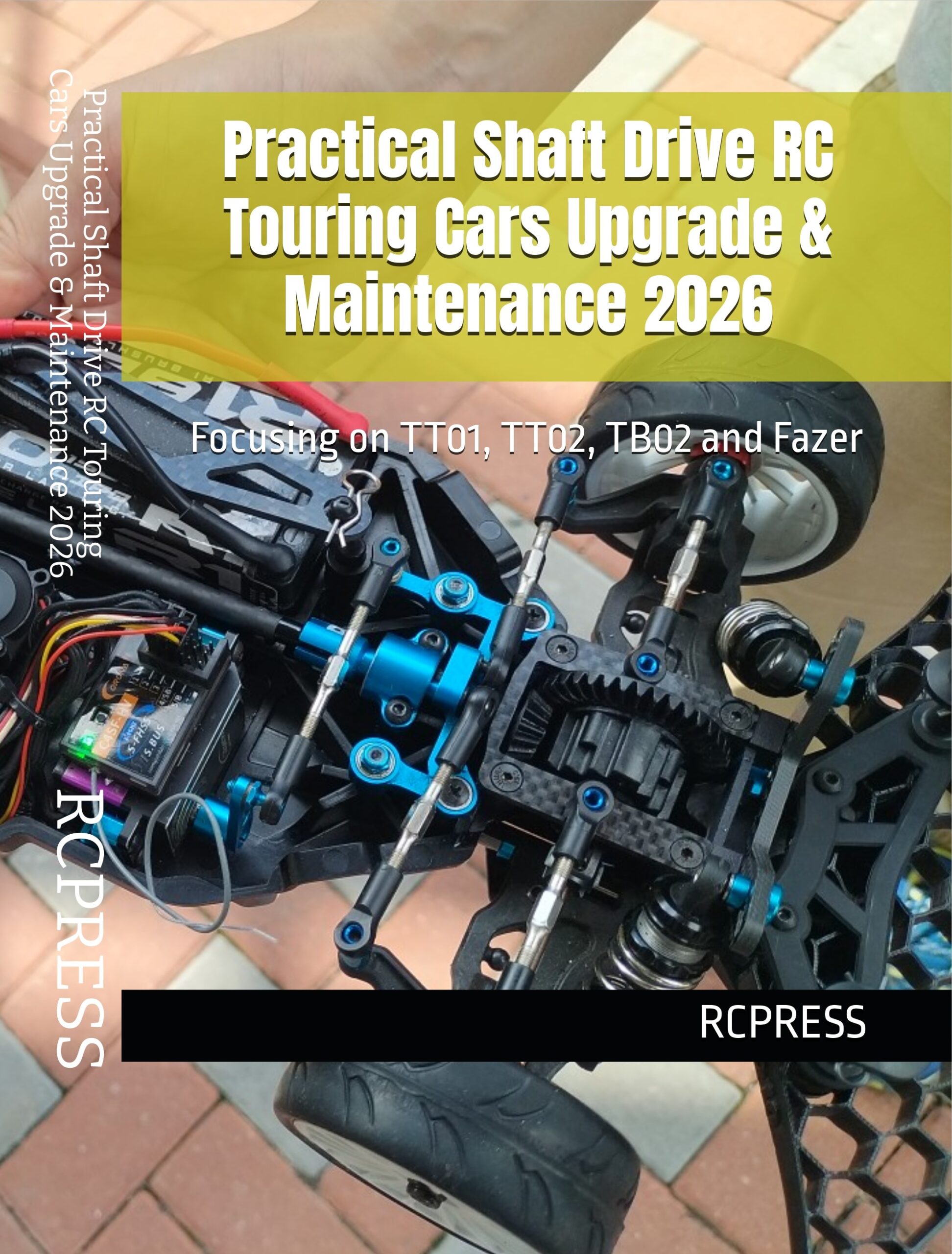
There is a certain honesty to a shaft‑driven touring car that belt‑drive enthusiasts never quite understand. The whir of a well‑meshed gear train, the direct thud of power landing through a solid driveshaft, the simplicity of a chassis that does not care about grit or gravel or the state of the car park tarmac—these are the sensations that have kept shaft‑drive cars on our workbenches and race tracks for decades. While the racing world has largely migrated to belt drive for its smoothness and efficiency, the shaft‑drive touring car has never disappeared. It has simply found its true home: in the hands of hobbyists who want to run their cars anywhere, without fuss, without constant cleaning, and without the fragility that sometimes accompanies high‑strung race machines.
This book is about four of the most important shaft‑drive touring cars ever made: the Tamiya TT‑01, the Tamiya TT‑02, the Tamiya TB‑02, and the Kyosho Fazer. Together, they represent the backbone of the entry‑level and mid‑range on‑road hobby. The TT‑01 and TT‑02 are the cars that introduced millions of beginners to the joy of building and driving a proper hobby‑grade RC car. The TB‑02 occupies a fascinating middle ground, a car that was designed as an affordable sports chassis, offering race‑derived features without the race‑derived price tag. And the Kyosho Fazer stands as the worthy rival, a modern interpretation of the shaft‑drive touring car that has kept Kyosho relevant in a segment dominated by Tamiya’s ubiquity.
Why focus on shaft drive? Because shaft drive is practical. A belt‑drive car demands clean surfaces and careful maintenance. A single small stone lodged between the belt and a pulley can shred a belt that is no longer in production. A shaft‑drive car laughs at that same stone. The gears are enclosed, the driveshaft runs through a sealed tube, and the entire drivetrain shrugs off the kind of abuse that would send a belt‑drive car back to the workbench. For the enthusiast who wants to run their car in a carpark, on a street, or even on a dusty tennis court, shaft drive is simply the smarter choice.
But practicality does not mean simplicity, and it certainly does not mean boring. The TT‑01, TT‑02, TB‑02, and Fazer each have their own quirks, weaknesses, and upgrade paths. The TT‑01, for example, is famous for its understeer and its fragile stock propeller shaft. The TT‑02 improved many of the TT‑01’s shortcomings but introduced its own eccentricities, including a steering system that benefits enormously from simple aftermarket fixes. The TB‑02 arrived with ball differentials and oil‑filled shocks as standard, making it a hidden gem for those who know where to look, but its parts are becoming scarcer every year. The Fazer offers a modern, robust alternative, with a sealed transmission and a design philosophy that prioritises durability over ultimate performance.
This book is written for the owner who wants to do more than simply assemble a kit and put it on a shelf. It is for the driver who has felt the frustration of a TT‑01 that refuses to turn in, the restorer who has acquired a tired TB‑02 from an online auction, the basher who wants to fit a LiPo battery into a Fazer without cutting the chassis, and the hobbyist who simply wants to understand why their car behaves the way it does. You will find practical, step‑by‑step guidance on upgrading suspension geometry, reinforcing weak points, choosing the correct gear ratios, and fitting modern electronics without destroying the character of the car.
The year 2026 marks a curious moment in the history of these chassis. The TT‑01 is now over twenty years old. The TT‑02, while still in production, has been on the market for more than a decade. The TB‑02 is a classic, its production long since ended. The Fazer continues to evolve, with Kyosho releasing new variants and bodyshells every few years. These cars are no longer new, but they are far from obsolete. They are, in many ways, the perfect candidates for the kind of practical, hands‑on hobbyist attention that this book provides. You do not need a sponsorship or a pit crew to enjoy these cars. You need a hex driver, a soldering iron, a willingness to learn, and a copy of this book.
So pull your TT‑01 off the shelf, dig that TB‑02 out of the cardboard box where it has been sleeping for a decade, or unbox the Fazer that you have been meaning to build. The shaft‑drive touring car is a robust, forgiving, deeply satisfying platform, and with the right knowledge, you can make it handle better, run faster, and last longer than its designers ever imagined. Let us get started.