
Book updated Apr 2026.
The “M” in the M-chassis stands for Mini, which is basically a smaller version of a typical 1/10-scale RC car. The typical upgrade goal for a Tamiya M-chassis car (like M03, M05, M07, M08) is to transform it from a fun, slightly soft-handling “toy-grade” car into a sharper, faster, race-capable mini touring car, without losing the playful driving character that makes M-chassis cars so beloved.
Welcome to the rewarding world of Tamiya M-Chassis RC cars—where small scale meets big fun. Whether you’ve just unboxed your first M-05, M-06, or M-07 kit, or you’re eyeing one as your entry into hobby-grade radio control, you’ve made an excellent choice. These nimble, front- and rear-wheel-drive machines are celebrated for their compact size, realistic hatchback bodies, and approachable handling—perfect for parking lot races, club circuits, or simply honing your driving skills.
But let’s be honest: even the best kit builds can leave beginners with questions. How do you make it handle sharper without breaking the bank? Which upgrades actually matter, and which are just shiny distractions? Why does your car pull to one side after a minor curb tap? And what’s the right way to maintain your differential so it doesn’t turn into a crunchy mess?
That’s where this book comes in.
Tamiya M-Chassis RC Cars: Practical Upgrade & Maintenance for Beginners strips away the guesswork and technical overload. I won’t drown you in racing theory or boutique parts lists. Instead, you’ll find guidance on:
Budget-conscious upgrades that deliver real performance gains (without needing a machine shop).
Essential maintenance routines that keep your M-Chassis rolling smoothly for years.
How to diagnose and fix common issues—from sloppy steering to mysterious drivetrain noises.
Choosing the right tires, springs, and dampers for grip and stability.
You’ll learn not just what to do, but why it works—building the confidence to experiment, tune, and eventually make your M-Chassis uniquely yours. So grab your hex drivers, clear a workspace, and get ready to transform that tidy kit into a durable, responsive, and genuinely quick little race car. Your M-Chassis is capable of far more than you think—let’s unlock it together.
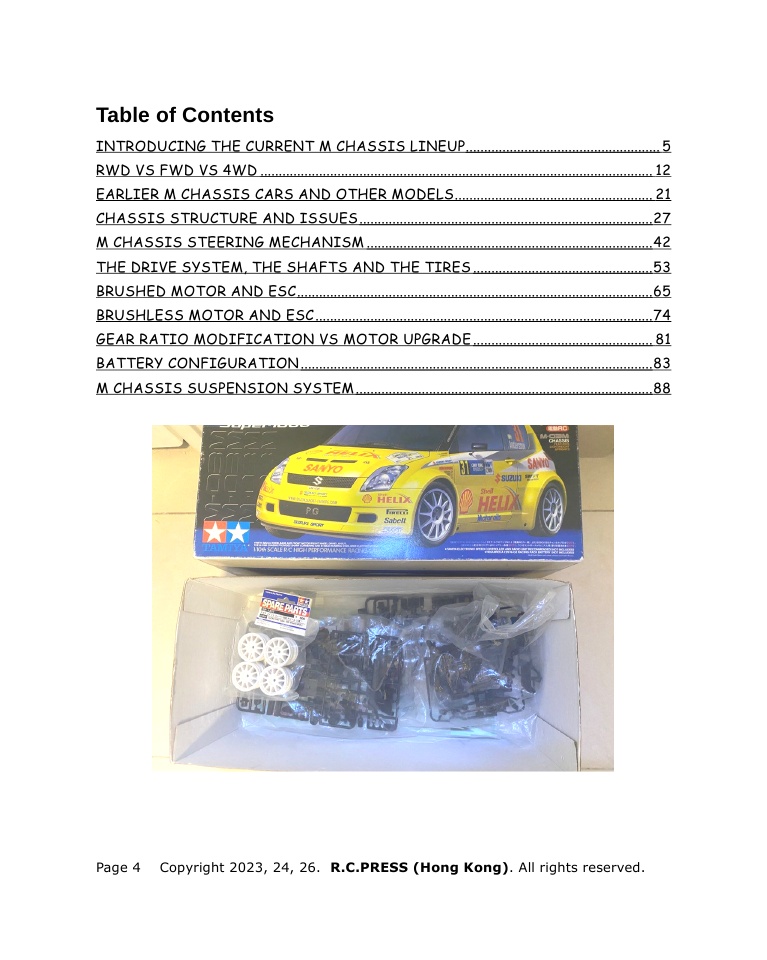

Let’s take a laid-back spin down memory lane with Tamiya’s charming M-chassis line—a fleet of compact, charismatic little RC cars that have earned a special place in the hearts of hobbyists around the world. From their debut with the M-01 in 1994 to the latest XM-01 AWD platform, the M-chassis series has thrived on adaptability, nostalgia, and unique driving fun. Initially created to host smaller-scale bodies—like the classic Mini Cooper—without distorting their proportions, Tamiya’s M-chassis grew into something much more: a beloved, affordable, and continually evolving entry into RC life. The odd-numbered models, such as the M-05, deliver front-wheel drive, while the even-numbered ones, including the M-06 and M-08, shift into rear-wheel drive territory. This choice in propulsion does more than rearrange your motor—it changes the car’s personality on the track.
For many, the M-05 is the gateway. Its compact monocoque frame houses a front-mounted motor, servo, gearbox, and battery in a layout that feels balanced and thoughtfully engineered. You can set it up in three different wheelbases—short (210 mm), mid (225 mm), or long (239 mm)—to suit different bodies or driving moods. Its double-wishbone suspension and resin construction make it light, nimble, and—above all—fun.
Turning corners is where the M-05 really shines. One Redditor summed it up with a grin: “The M-05 is unbelievably easy to drive. This was the chassis I introduced my kids to R/C with”. Even after ten years of minimal maintenance, others report it still drives just as smoothly as day one. If you’re building or customizing one, most seasoned builders recommend investing in a bearing set and oil-filled shocks to elevate the smoothness—steering precision really benefits from these upgrades. And yes, the mini-CVA shocks might break the bank, but they pay off in ride quality. One builder even quipped how cheap aluminum shocks just didn’t cut it compared to Tamiya’s own bits—staying true can sometimes get you further.
Enter the M-06: Tamiya’s rear-wheel drive answer, introduced in 2011 with a rear-mounted motor and longitudinal battery placement. It delivers a different energy—more tail-happy, potentially less forgiving in tight turns compared to the M-05’s composed front-drive feel. One user described it like this: “I found the front does not grip as well as the M-05 in turns. The M-05 front wheel drive is great when cornering and the motor and battery is within the wheelbase with better weight distribution”.
Still, nearly every track seems to embrace M-chassis racing. The platform is a budget-friendly, low-pressure way into competition—bodies are fun, rules are light, and the cars may be slower than full-size touring rigs, but that simply makes it all about driving skill. Then there’s the M-07 and M-08, where Tamiya went full race-spec. These models leap forward with modern designs, adjustability, and enhanced drive dynamics. The M-08 Concept, for instance, boasts a midship motor, oil-filled diffs, CVA dampers, universal shafts, and three wheelbases—all designed around tunability and performance, and clearly made for the track enthusiast. The M-08R ups the ante with aluminum parts, ball differentials, carbon fiber mounts, and high-bore dampers—bringing sophistication and bling in equal measure. And the lineage doesn’t end there. In recent years, Tamiya introduced the MF-01X for AWD mini-offroad fun, and the more recent MB-01 and XM-01 add even more drivetrain versatility—FWD/RWD and full AWD respectively—so the M-chassis lineage remains spry.
All in all, the M-chassis family captures what many RC hobbyists love most: a roller coaster of nostalgia, community support, creative builds, and real driving feel—all in a compact, accessible package. Want to dive into custom bodies, or see what hopping from M-05 to M-08 really changes on the road? I’m ready when you are.