

Welcome to the world of one of Tamiya’s most iconic and beloved off-road machines. If you are holding this book, chances are you have either just unboxed a shiny new re-release of the Hotshot, discovered a dusty vintage chassis in your attic, or found yourself captivated by the sight of this legendary buggy tearing across a dirt track. Whatever brought you here, you have taken the first step toward truly understanding and mastering the Tamiya Hotshot chassis.
The Tamiya Hotshot first roared onto the scene in 1985. It was a revolutionary moment for radio-controlled cars. At a time when off-road buggies were largely simple and exposed, the Hotshot arrived with a futuristic, fully enclosed body that looked like it had driven straight out of a science fiction film. Beneath that striking blue polycarbonate shell lay engineering that was just as groundbreaking. The Hotshot featured a rigid, die-cast aluminium chassis frame, four-wheel independent suspension, and a unique shaft-driven four-wheel drive system that set it apart from nearly everything else on the market. It was fast, it was tough, and it looked like nothing else on the track.
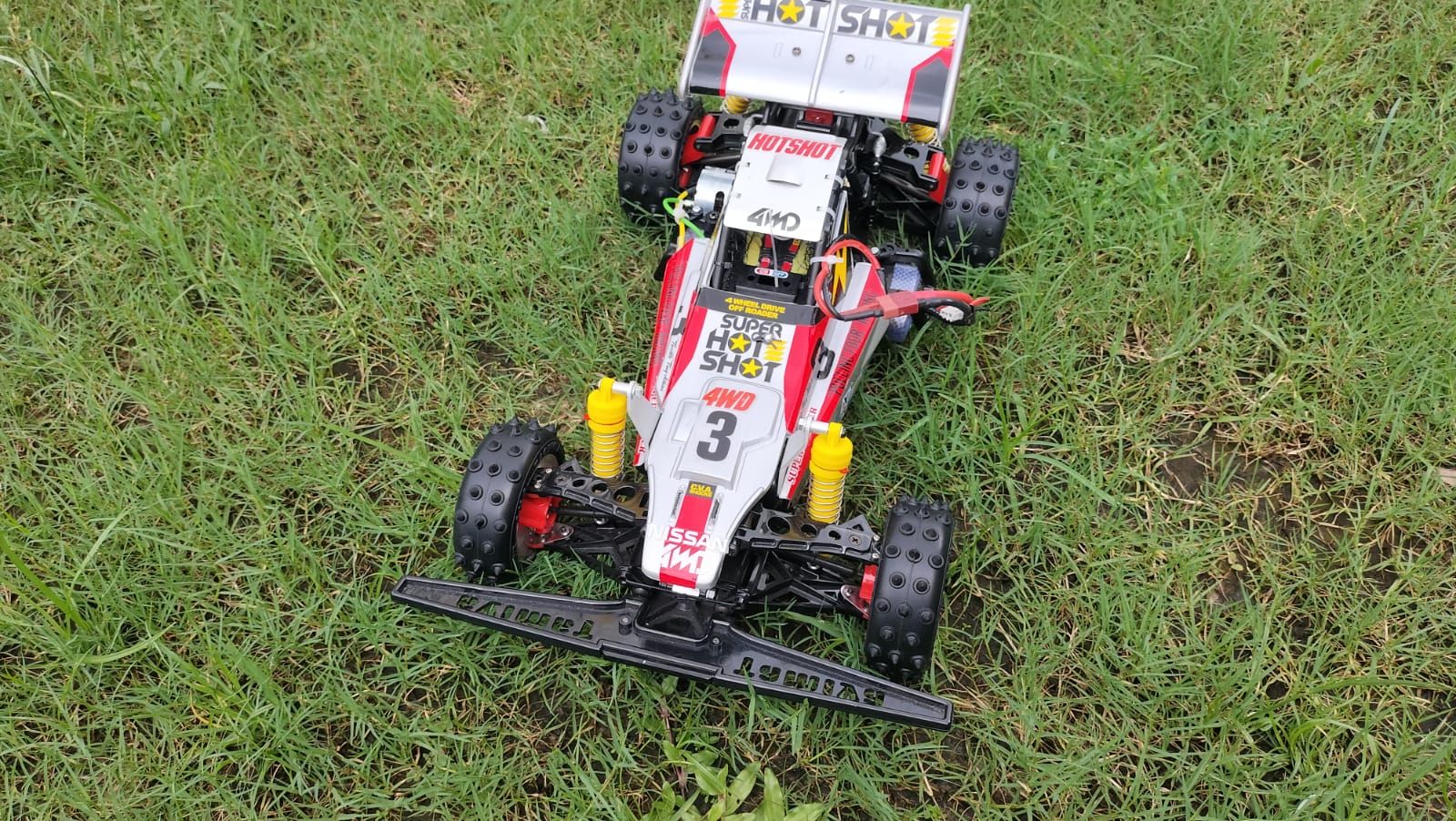
However, owning and maintaining a Hotshot comes with unique challenges that every beginner should understand. This is not a modern, ready-to-run plastic buggy with interchangeable parts from a dozen different manufacturers. The Hotshot is a machine with personality, and like any classic performance vehicle, it demands specific knowledge and care. The steering system, for example, is famously complex and can be frustrating for first-time builders. The suspension, while advanced for its era, has quirks that affect handling. The drivetrain, with its unusual combination of gears and shafts, requires proper assembly and maintenance to run smoothly. And when you start thinking about upgrades, the sheer number of options from Tamiya and aftermarket brands can feel overwhelming.
This book is designed to guide you through exactly those challenges. It is written for the beginner who is not afraid to turn a screwdriver but wants clearer examples. We will cover practical maintenance tasks such as cleaning and rebuilding the gearboxes, adjusting the suspension, and keeping the unique steering system in working order. We will identify the most common problems and show you how to fix them. Finally, we will explore sensible upgrades, from oil-filled dampers and universal joint shafts to modern electronic speed controllers and brushless motors, helping you decide which modifications are worth your time and money.
The goal of this book is not to turn your Hotshot into a shelf queen that never sees dirt. The goal is to help you build a reliable, capable, and genuinely enjoyable runner that you are confident to drive, maintain, and repair yourself. Whether you want to relive the golden age of off-road racing, experience the unique charm of one of Tamiya’s most creative designs, or simply learn how to keep a classic machine alive, you have come to the right place. Let us get started.

So after spending some time with both the Kyosho Optima re-release and the Tamiya Hotshot re-release, I’ve started to notice how different these two classic buggies feel — even to someone like me who’s still fairly new to RC racing. Both are legendary 4WD machines from the 80s, but driving them back-to-back really shows their personalities.
The Hotshot is pure Tamiya charm. It looks amazing — that sleek red body, the funky suspension layout, and the big off-road stance. But once you get it on the dirt, you can tell it’s a product of its time. The mono-shock suspension (one shock shared between both wheels in the front and rear) feels a little bouncy and stiff, and it doesn’t soak up bumps as well as more modern setups. As a beginner, that means you’ve got to be more careful with your throttle and steering inputs. Still, there’s something satisfying about wrestling it around a track — like you’re driving a piece of RC history that makes you earn every clean lap.
The Optima, on the other hand, feels more refined. Even though it’s also an 80s design, Kyosho built it with racing in mind, and you can tell. The suspension is more traditional with four independent oil shocks, and the aluminum ladder frame gives it a stiffer, more precise feel. It’s still old-school, but it drives smoother and handles bumps with a bit more composure than the Hotshot. As a beginner, that gave me more confidence to push it without feeling like the car was fighting me.
Where the Hotshot wins for me is in character. It’s quirky, it looks iconic, and it’s just plain fun to see it bouncing along. But if I were picking one to actually try learning racing basics on, the Optima would be my choice. It’s easier to drive consistently, and the whole build feels sturdier and more “engineered.”
Both of them attract attention, though. When I bring them out, people stop and want to talk about them — the Hotshot because it’s such a Tamiya classic, and the Optima because of its chain/belt drive and polished metal frame. As a beginner, that’s half the fun: you’re not just learning to drive, you’re also connecting with a whole RC culture that stretches back decades.
So if you’re starting out and want something more forgiving, I’d say the Optima is the way to go. But if you’re up for a challenge and love the idea of piloting a vintage icon with tons of personality, the Hotshot will definitely make you smile.


