
If you’re new to the hobby, the terminology alone can be confusing. You’ll see “nitro” cars advertised everywhere, and then you’ll stumble upon massive 1:5 scale beasts labeled “petrol.” They both burn fuel and make noise, so what’s the actual difference? The short answer is yes, they are technically completely different, and that difference starts with what you pour into the tank and ends with how the whole thing feels to own and drive.
The most fundamental difference lies in the fuel itself. Nitro cars don’t actually run on “nitro” alone. The fuel is a carefully blended cocktail of methanol, which serves as the primary fuel, nitromethane, which is a power-boosting additive, and a hefty dose of lubricating oil that is often castor or synthetic. The percentage of nitromethane, usually somewhere between ten and forty percent, determines the power and how aggressively the engine runs. The higher the nitro content, the faster you go, but the more expensive the fuel becomes and the shorter your engine’s life tends to be. Petrol cars, on the other hand, run on ordinary pump gasoline mixed with two-stroke oil, just like a weed whacker or a chainsaw. The manual for a typical petrol RC engine specifies a twenty-five to one ratio of high-octane gasoline to high-grade two-cycle oil. This fuel is cheap, widely available, and has a much longer shelf life than nitro blends.
Here’s where the mechanics get truly interesting. A nitro engine uses a glow plug, and despite the name, there is no spark. The plug contains a platinum-alloy coil that you heat up with an external igniter to start the engine. Once running, the heat of combustion and a catalytic reaction with the methanol keeps the coil glowing red-hot, which ignites the next fuel charge. It’s a self-sustaining cycle that relies on thermal inertia. A petrol engine uses a conventional spark plug, just like a full-size car. An ignition coil fires a timed spark to combust the fuel-air mixture. This requires a more complex ignition system, but it allows for precise timing and reliable combustion.
The engines themselves are built very differently too. Nitro engines are typically tiny, high-revving two-stroke powerhouses designed for small-scale vehicles, usually in the 1:10 or 1:8 range. They can spin at absurd RPMs, often between twenty-five thousand and thirty-seven thousand, with some reaching over fifty thousand. The trade-off is low torque and a peaky power band that demands you keep the engine in its sweet spot. Petrol RC cars are much larger, almost exclusively 1:5 or 1:6 scale. Their engines are essentially miniature versions of scooter or chainsaw motors. They turn much lower RPMs but produce significantly more torque, which is necessary to move their considerable weight.
The practical differences between the two are stark when you actually live with them. A nitro car will empty its tank in five to fifteen minutes, while a petrol car, being more efficient and carrying a larger tank, can run for twenty to forty-five minutes per fill. Nitro engines are notoriously finicky, and you’ll constantly adjust the carburetor needles for temperature, humidity, and altitude. Petrol engines are far more forgiving and are often described as one tune, a few pulls of the starter, and you’re going. The sound is completely different as well. Nitro engines scream with a high-pitched, Formula One-like wail, while petrol engines have a deeper, throatier growl that sounds like a mini dirt bike.
So, are they technically different? Absolutely. One is a methanol-fueled, glow-ignition, high-RPM screamer, and the other is a gasoline-fueled, spark-ignition, torque-heavy bruiser. If you want the ultimate in speed and realism for a smaller scale, nitro is your ticket. If you prefer convenience, lower running costs, and the sheer presence of a massive 1:5 scale machine, petrol is the way to go. Just don’t call a nitro car a gas car, because the purists will never let you hear the end of it.
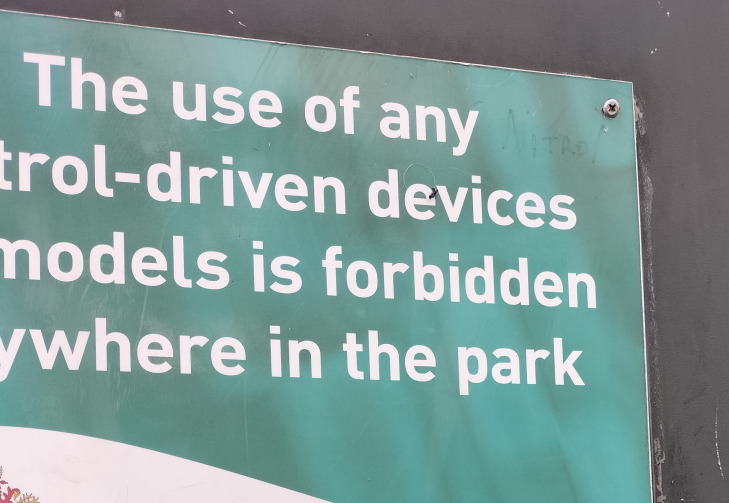
Because petrol and nitro cars are technically different, a track’s ban on “petrol” doesn’t automatically extend to “nitro.” However, the reality of why tracks ban petrol cars often dictates the answer anyway.
Tracks that disallow petrol cars usually do so for reasons that can also apply to nitro, namely noise, fumes, and fire safety. A key distinction to remember is that most indoor tracks do not allow nitro cars either. Indoor racing is typically dominated by electric vehicles because they don’t produce exhaust fumes or the loud, high-pitched noise of a nitro engine. If a track bans petrol for these reasons, a nitro car will almost certainly be off-limits too, since nitro engines are similarly loud and produce their own distinct exhaust smell.
That said, there are situations where a petrol ban wouldn’t affect nitro. Some outdoor tracks or specific race events are explicitly designed for fuel-powered cars, and their rulebooks often distinguish between the two. For example, a track’s rules might have specific technical regulations for 1/10 200mm Nitro Touring cars, detailing engine displacement limits and fuel tank capacities. Another rulebook might state that nitros may run on Sunday, indicating a scheduled time slot for them. In these cases, the ban is likely aimed at the larger 1:5 scale petrol cars, which are a different class entirely.
The only way to know for sure is to check the track’s rulebook or ask directly. When you look, be specific about what you’re searching for. Does the rule say no petrol or gas cars, or does it say no nitro or gas, or electric only? If it’s an indoor track, the answer is almost certainly no for both. If the track hosts nitro classes, then there is a designated place for them.
So a ban on petrol cars doesn’t technically guarantee that nitro is banned, but in practice, especially at indoor tracks, the reasons for banning one often apply to the other. Always confirm with the track directly before you show up with your car.


