
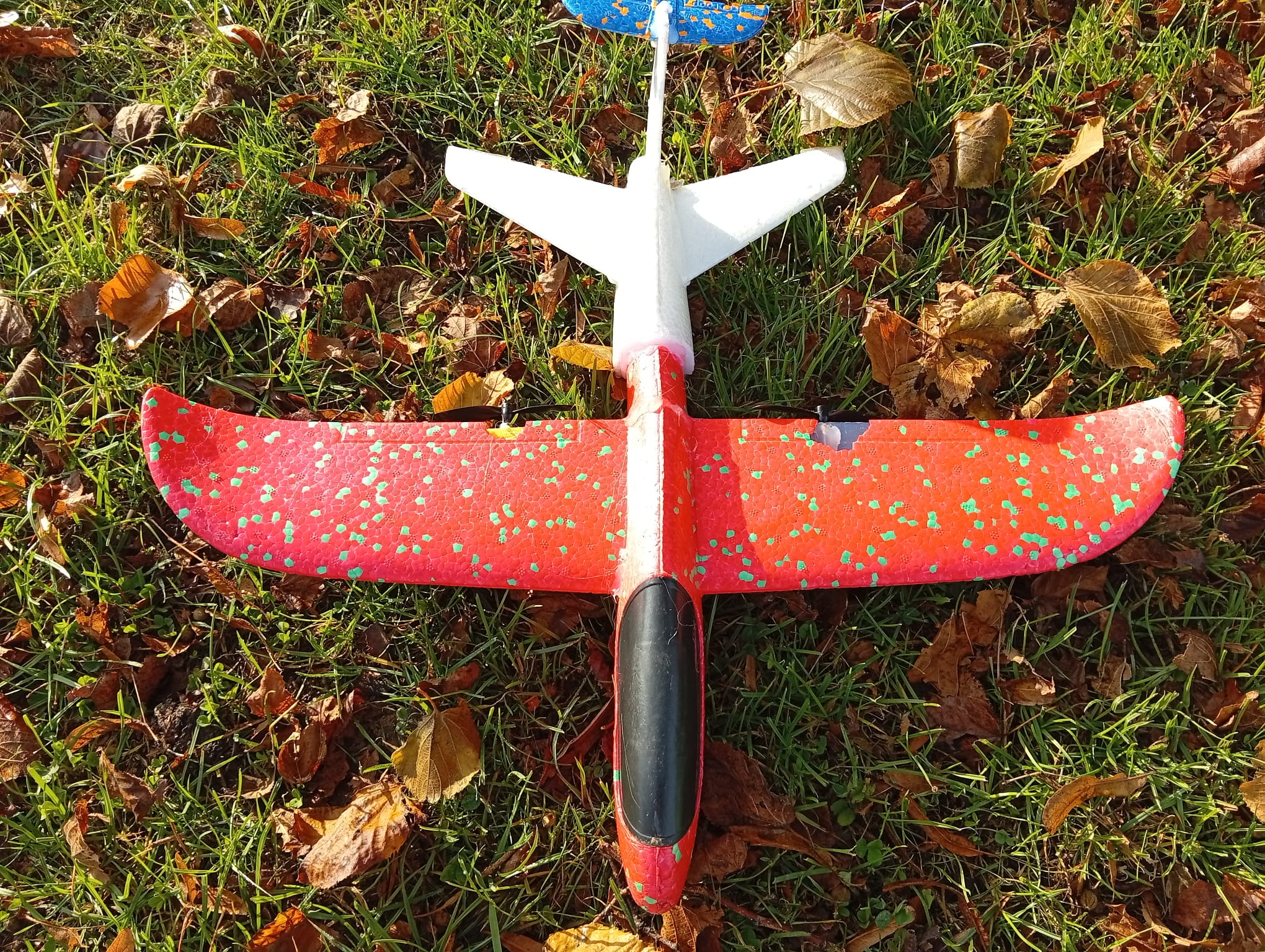
Propwash is the accelerated, swirling slipstream hitting the tail. While the line of thrust is about the motor’s push, propwash is about how that push changes the air over your control surfaces. This is where the two concepts interact. The effect of the propwash can either compensate for or amplify the direct pitching moment from the thrust line.
When you build a differential thrust glider, the first thing you learn is that the motors do the turning. Vary the thrust between left and right, and the glider yaws. Simple. So why do experienced builders keep talking about propwash as if it’s some kind of secret ingredient? Because it is. Not for the turning itself, but for everything that happens around it.
The real problem with a glider is that it flies slowly. That’s the whole point of a glider, after all—efficiency, float, and gentle handling. But slow flight means low airflow over your control surfaces. This is where propwash earns its keep. The propellers are constantly blasting a stream of fast-moving air backward over the tail, and that artificial airflow wakes up the control surface – especially the tail, as it is sitting in the propwash to create a balancing aerodynamic force that stabilizes the pitch attitude as you move the throttle.
Of course, there is such a thing as too much of a good thing. If your motors are oversized and spinning big, aggressive props, the propwash becomes a violent spiral of air that can actually fight against your intended turn, introducing unwanted roll or yaw. This is why many builders deliberately choose smaller, more efficient props. You want just enough propwash to keep the tail alive and responsive, not so much that it destabilizes the lightweight airframe.
The difference in airflow with and without propwash comes down to one word: energy. Without propwash, the air flowing over your glider’s tail is just the ambient air the plane is flying through—slow, uniform, and at low speeds during a gentle glide, barely enough to keep the control surfaces awake. With propwash, that same air has been grabbed by the propellers, accelerated, compressed, and spun into a fast-moving spiral before it ever reaches the tail.
The most immediate change is dynamic pressure. The slipstream behind a spinning propeller carries significantly more energy than the surrounding freestream air. In typical climb conditions, the dynamic pressure inside the propwash can be roughly 20% higher than the ambient airflow. For a slow-flying glider, that difference is transformative. The tails suddenly find themselves sitting in a stream of air moving noticeably faster than the plane itself, which means they bite harder and respond more crisply. The control surfaces haven’t changed—the air hitting them has.
There’s also a boundary layer effect worth mentioning. The fast-moving propwash can delay airflow separation over the surfaces it touches . In practical terms for a glider, this means the tail stays “attached” and effective even at angles or speeds where it might otherwise start to feel vague or stall. The propwash essentially keeps the tail flying when the rest of the plane is barely moving. Without propwash, you’re relying entirely on the glider’s forward speed to generate control authority. In a dive or a fast pass, that’s fine—the tail sees plenty of air. But at launch, in a slow thermal turn, or on final approach, the difference is stark.